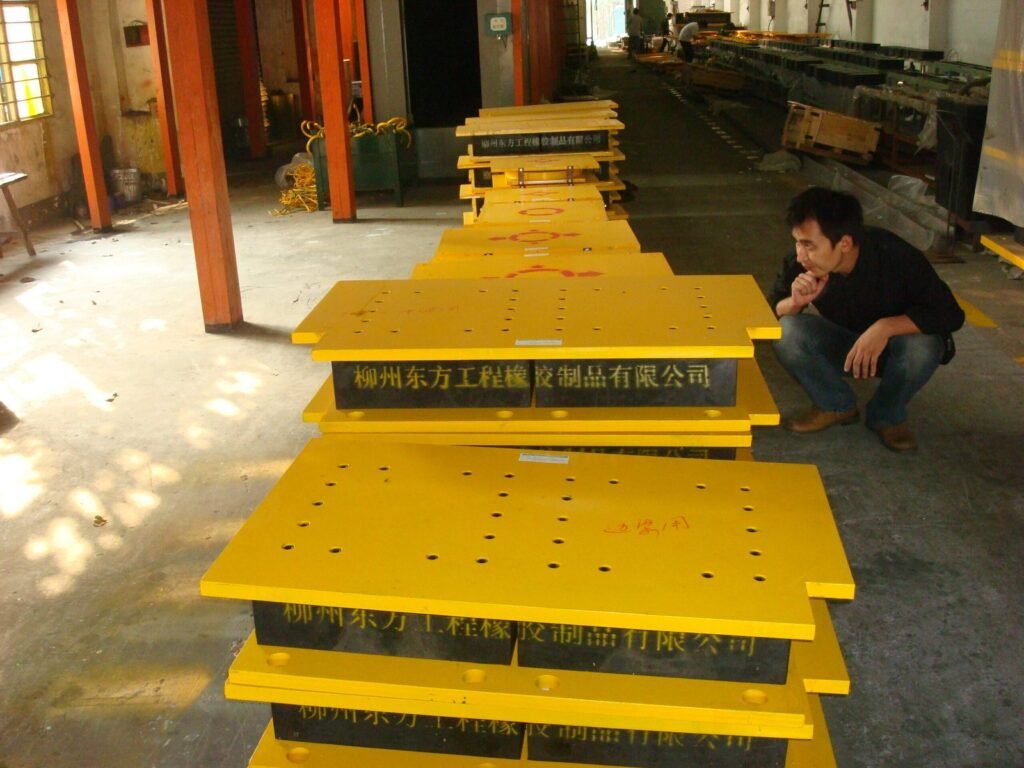
Rubber Plate
Silence the stress between structure and support — KIDL’s Rubber Bearing Plates absorb load, accommodate movement, and protect concrete surfaces with quiet, proven elastomeric engineering built for a lifetime of service.
Product Type
Plain / Laminated Elastomeric
Material
Natural / Neoprene Rubber
Hardness
50 – 70 Shore A
Load Capacity
Up to 10,000 kN
Standard
BS 5400 / EN 1337 / AASHTO
Overview
Rubber Bearing Plates are elastomeric structural components placed between a superstructure and its supporting substructure to transfer vertical loads while simultaneously accommodating horizontal movement, rotation, and vibration. They act as a flexible interface that prevents direct hard contact between concrete or steel elements, protecting both from stress concentration and surface damage.
KIDL supplies both plain rubber pads and steel-laminated elastomeric bearing pads engineered to international standards. Plain pads suit lighter loads and moderate movements, while laminated bearings — with alternating layers of rubber and steel — handle heavy axle loads, large rotations, and significant translational movement with exceptional precision.
From bridge bearing replacement to industrial machinery isolation, KIDL’s Rubber Bearing Plates provide the quiet, maintenance-free performance that keeps structures safe, stable, and silent for decades.
Specifications
| Parameter | Detail |
|---|---|
| Bearing Types | Plain Pad, Laminated, Pot Bearing, Sliding |
| Elastomer Material | Natural Rubber (NR) / Chloroprene (Neoprene / CR) |
| Hardness (IRHD / Shore A) | 50, 60, 70 Shore A (±5) |
| Tensile Strength | ≥ 15 MPa |
| Elongation at Break | ≥ 400% |
| Compression Deflection | ≤ 15% under design load |
| Vertical Load Capacity | 100 kN – 10,000 kN (size-dependent) |
| Shear Modulus | 0.7 – 1.2 MPa |
| Temperature Range | −40°C to +60°C |
| Standards | BS 5400 Part 9, EN 1337-3, AASHTO M251, BNBC |
Applications
- Bridge Beam Bearings
- Building Column Pads
- Precast Beam Supports
- Railway Bridge Bearings
- Seismic Isolation Pads
- Industrial Machine Mounts
- Staircase & Floor Pads
- Port & Jetty Fenders
Advantages
Installation
1. Bearing Area Preparation
Clean the bearing seat surface thoroughly. Remove all dust, laitance, oil, and loose material. The seating surface must be level, smooth, and flat — permissible tolerance ±2 mm under a 3 m straightedge.
2. Levelling Mortar Application
Where the bearing seat is uneven, apply a thin layer of non-shrink epoxy or cementitious levelling mortar. Allow full cure before placing the bearing pad to ensure uniform load distribution.
3. Bearing Pad Positioning
Place the rubber bearing plate centrally on the prepared seat. Align precisely with the beam centreline and check plan dimensions. Do not drag the pad across the surface — lift and place to avoid displacement.
4. Beam Lowering & Seating
Lower the beam or superstructure element slowly and squarely onto the bearing pad. Confirm that the pad is fully covered by the beam soffit with no overhang beyond the design edge distance.
5. Load Verification & Inspection
After full load transfer, inspect the pad for uniform compression, no lateral extrusion beyond 10% of total thickness, and correct plan position. Record pad dimensions and condition in the QA log.
6. Protective Sealing (if required)
For exposed bearings in aggressive environments, apply an approved elastomeric sealant around the pad perimeter to prevent water ingress, chemical attack, and UV degradation over the service life.